
How to Prepare for NIFT 2026: Section-wise Preparation Tips & Strategy


Professional opportunities in fashion design and related fields are offered by the National Institute of Fashion Technology (NIFT). The purpose of the NIFT Exam is to evaluate candidates' skills in observation, sketching, creative writing, and visualization. Every year, more than 20,000 people apply for NIFT; those who are accepted are chosen on the basis of merit. As a result, learning how to study for the NIFT 2026 admission exam should be everyone's primary objective. As a result, students can organize their NIFT preparation using the information provided in this article.
This Story also Contains
- NIFT 2026 UG Courses
- How to Prepare for NIFT 2026 - For Beginners
- NIFT 2026 - GAT Syllabus
- NIFT Entrance Exam 2026 - CAT Syllabus
- Section-wise Preparation Strategy For the NIFT Exam 2026

NIFT 2026 UG Courses
Individuals who are taking the NIFT entrance exam for the first time should be aware that there are two degree programmes offered by NIFT: Bachelor of Design (BDes) and Bachelor of Fashion Technology (BFTech).
BDes.: Graduates of this program are prepared to lead the fashion business as its creative directors. B.Des. graduates, who work as stylists, illustrators, and fashion designers, realize their creative vision. They are employed by retail businesses, fashion firms, and design studios, among other fashion-related sectors.
BFTech.: This curriculum develops technical experts in the industry. Graduates can pursue careers in sourcing, quality assurance, and production management, which together make up the technical core of the apparel and textile sectors.
You may also check:
- NIFT 2025 Question Paper with Solutions
- NIFT 2025 Exam Analysis (B.Des & B.FTech) by Careers360
- NIFT B.FTech 2025 Question Paper with Solutions
- NIFT B.Des 2025 Question Paper with Solutions
- NIFT M.Des 2025 Question Paper with Solutions
- NIFT CAT 2025 Question Paper with Answers
- NIFT GAT 2025 Question Paper with Answers
- NIFT Situation Test Previous Year Question Paper with Solutions
How to Prepare for NIFT 2026 - For Beginners
The NIFT program is divided into three phases: GAT, CAT, and Situation Test. The weight section carries are already mentioned above. In this article, we will focus on preparing for the NIFT BDes program.
- Start Early: It is always good to start early, immediately after the intermediate/board examination, to cover the entire course, covering the whole syllabus for both the GAT(General Aptitude Test) & CAT(Creative Ability Test).
- Study Plan: Distribute the time to focus on all the subjects related to the NIFT - exam preparation strategically which is explained below in detail under the "Section-wise Preparation Strategy" section.
- Understand the NIFT Exam Syllabus in Detail: Clarity of the NIFT 2026 Exam syllabus would help an aspirant in preparation for the NIFT entrance exam. It will help to map the strengths and weaknesses of the aspirant. Accordingly, they can plan on the time distribution to different subjects and topics. The list of important topics of NIFT 2026 is as follows.
- Understand the NIFT 2026 exam pattern: Aspirants appearing for the NIFT entrance test must go through the exam pattern of NIFT. In the written entrance exam, students sit for the General Ability Test (GAT) for both BDes and BFTech programmes whereas only BDes candidates can take the Creativity Ability Test (CAT) and Situation Test. Hence, for NIFT entrance exam preparation students must be acquainted with the important topics for NIFT preparation. Also, note that the mode of examination for GAT is CBT (Computer Based Test).
Particulars | BDes | BFTech |
Phase 1 | GAT (General Ability Test) | GAT (General Ability Test) |
CAT(Creative Ability Test) | ||
Phase 2 (After qualifying Phase 1) | ST(Situation Test) |
NIFT 2026 - GAT Syllabus
Given below is the list of important topics taken from the NIFT GAT syllabus.
Comprehension in English
General knowledge
The current affairs
Quantitative Ability
Analytic ability
Communication ability
NIFT Entrance Exam 2026 - CAT Syllabus
Given below is the list of important topics taken from the NIFT-CAT syllabus.
Designing ability
Illustration skills
Knowledge and use of colour palette
Intuitive ability
Observation power
Section-wise Preparation Strategy For the NIFT Exam 2026
1. NIFT CAT (Creative Ability Test) 2026
Exam Duration: 03 hours
Number of Questions: 03
Weightage: 50%
This section holds the most weightage, so this is the most crucial phase of the NIFT Entrance Examination, Phase-01, for getting into B Des. Program. Through this section, they are looking for someone with the following skills:
Visual Articulation of Ideas
Knowledge of Surrounding
Problem-Solving Approach
Creative Narrative for Design
Tips for Successfully Cracking the NIFT CAT(Creative Ability Test)
Aspiring students can follow these tips given below for their preparation for NIFT CAT Exam:
Avoid Overdoing
It is a common observation that aspirants waste more time overdoing than required.
In most cases, either over-detailed or over-colouring the solutions should be avoided unless asked or if it is essential to highlight the concept.
For a fashion accessory inspired by the beetle, only elements driven by a beetle need to be highlighted.
Focus on Visual Articulation of Idea
The approach should focus more on visual narration of the simple idea instead of thinking very complex or futuristic.
Practise Human Figures
Most solutions we provide are around users, such as fashion accessories, futuristic apparel, footwear, etc.
A good sketch of the idea with human interaction is an incomplete story.
It also gives an idea of the scale proportion of the proposed solution.
Plan the outcome through Thumbnail Sketches:
It is always advisable to quickly
Sketch the composition in a thumbnail format before jumping directly to answer sheets.
It helps to plan better and save time while executing the final concept.
NIFT CAT (Creative Ability Test) Sample Question:
Design a Headgear for any of the given characters, explaining the qualities of the headgear.
Mythological Character
Underwater animal
Alien on Earth
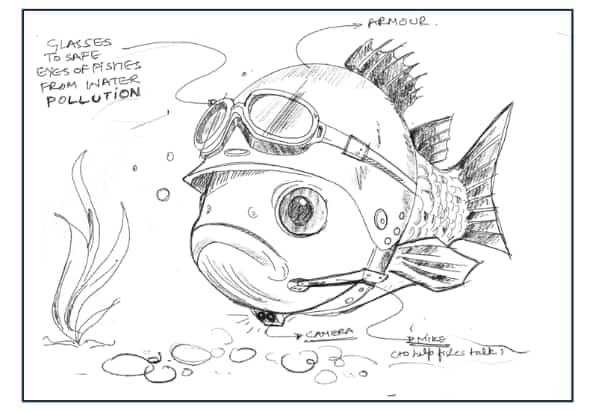
This is only one sample of the kinds of questions that can come in the NIFT CAT exam. By clicking on the NIFT CAT Question Paper article link, you can solve more NIFT CAT questions.
Also Check:
2. NIFT GAT (General Ability Test) 2026
The NIFT GAT-Exam is designed for students to test their abilities in Language competence, Fashion industry trends, general awareness around the world, and critical thinking abilities. The NIFT GAT exam is held online and lasts for 2 hours. The GAT is a critical section for qualifying NIFT since it contains 30% weightage. The exam pattern for GAT for both BDes and BFTech programs is as follows.
Sections | BDes - GAT | B F Tech - GAT | |
No. of Questions | No. of Questions | ||
Section A | Section B | ||
Communication Ability | 40 | 40 | NIL |
English Comprehension | |||
Quantitative Ability | 20 | 20 | 15 |
Analytical & Logical Ability | 15 | 15 | 15 |
General Knowledge and Current Affairs | 25 | 25 | NIL |
Case Study | NA | NA | 20 |
TOTAL | 100 | 150 | |
Exam Duration: 02 hours
Number of Questions: 100 in BDes and 150 in BFTech
Weightage: 30%
This section aims to check if the aspirant is aware of its surroundings. This is necessary in the later stages of a career to evolve with the needs and trends of the industry. GAT is a scoring section if the efficiency of preparations is maintained from the beginning through a proper study plan. GAT focuses on the following areas, for which, again, the detailed syllabus can be accessed from the official website of NIFT. This section comprises the following topics.
- General Awareness
- Reasoning Ability (Verbal & Non-verbal)
- Mathematics Elementary Concepts
- English Comprehension and Grammar
Also Read:
Tips for Successfully Cracking the NIFT GAT (General Ability Test)
Speed & Accuracy: An aspirant must maintain speed and accuracy by regularly practising the sample questions from previous years' papers in their preparation for NIFT GAT Exam.
Focus on Strength Areas/Topics: It is always good to work on topics and practice the sections first so that it feels more confident. It is only sometimes necessary that one excels in all the sections, but it is better to focus on topics one feels most optimistic about.
Study Precise and Revise More: The human mind tends to forget the old information to retrieve new information. However, we can train the mind to retrieve more information by revising the concepts frequently. Thus, if time is short, focus more on revision instead of focusing on new topics.
Find Interrelations in Topics: Sometimes, we feel discouraged looking at the huge syllabus for any competitive examination, but if we plan things smartly, we can remember more by interconnecting the topics. For. E.g. Topics like Percentage, Ratio & Proportion, Profit Loss, Speed, & Distance are connected fundamentally in approach.
NIFT Situation Test 2026
Exam Duration: 02 hours
Number of Questions: 03
Weightage: 20%
The Situation Test is a crucial component of the B.Des program selection process, thus candidates must prepare for the NIFT Situation Test thoroughly. The situation tests the following skills in an aspirant.
Model Making
Material Exploration
Practical Approach
Material Usage
Colour composition
Innovation in the idea
One is required to make a 3D model for a given question/objective. Further, the aspirant is required to justify the solution through a short write-up. The materials are disclosed only during the examination; however, the commonly provided materials are :
Modelling Clay
Old Newspapers
Paper Straws
1-2 mm Soft wire
Colourful papers, etc.
Tips for Successfully Cracking the NIFT Situation Test
Plan the model in 2D on the given sheet through sketch before proceeding with the provided materials. This helps you quickly visualise the proposed concept/solution and make any modifications easily without wasting time.
Use the materials wisely; this should also be planned while exploring the concept on the paper. Tentatively plan the dimensions on paper only.
Get more proficient in solving the Situation Test questions by practising the previous year's NIFT Situation Test questions and some sample questions.
Top Design Entrance Exam
Frequently Asked Questions (FAQs)
The NIFT-GAT section can be considered easy because it contains a syllabus up to the undergraduate level. However, because of its emphasis on design and creativity aptitude, this exam can be difficult. For this reason, students might increase their chances of success by concentrating and working hard.
The list of Important topics of NIFT 2025 are as follows:
General knowledge and current affairs.
Case Study.
Effective Communication.
Communication ability and English comprehension.
Quantitative.
Problem-solving approach.
Analytical and logical ability
Modelling, Sketching
The time required to prepare for NIFT depends upon your hard work and determination. But the better the early students start their preparation, the more beneficial for them to cover the syllabus and practice accordingly.
To prepare for thethe NIFT entrance exam 2025 at home, aspirants can follow these steps.
First to understand the NIFT exam pattern thoroughly.
Secondly to make a study time-table and study consistently and accordingly
Last is to attempt the as many mock tests as possible.

Popular Courses and Specializations
Browse Design Colleges by State
Questions related to NIFT Entrance Exam
On Question asked by student community
Hello aspirant,
The nationwide Institute of Fashion Technology offers a nationwide entrance exam called NIFT for admission to its fashion design programmes.
Every course has specific requirements that must be met in order to apply. For NIFT, there is no minimum age requirement, however it is evident that passing the 10+2 exam is a requirement in order to be admitted to any undergraduate programme in fashion design.
You cannot be admitted because you are in class eleven. However, you can apply to NIFT for experience and practice, and if your application is accepted, you can take the entrance exam. If you pass, however, be aware that you will not be able to retain your results for admission.
Thank you
Hope this information helps you.
Dear Aspirant,
Yes! If you want to pursue your under graduation from nift after 12th or even if you are appearing for12th exam then you are eligible to apply for the exam. There are several courses offered by nift which includes undergraduate and postgraduate degree programmes.
Age (Undergraduate degree programmes) -
- General - the maximum age should be less than 24 years as on 1st august in the year of examination
- Reserved category - 5 years relaxation
Hope this information helps :)
Dear aspirant
NIFT 2023 ELIGIBILITY - B.DES admission
1. Aspiring students must have completed a 10+2 board exam from any recognized Central/State Board of Secondary Examination, such as Central Board of Secondary Education/State Board New Delhi, and Council for Indian School of Certificate Examination, New Delhi or,
2. Any Board/Public School/University Examination conducted in India or abroad which is equivalent to the 10+2 system and is accorded by the Association of Indian Universities or,
3. If candidates complete the General Certificate Education (GCE) Examination (London/Sri Lanka/ Cambridge/) at the Advanced (A) level/International Baccalaureate (IB) then, they are eligible to apply or,
4. Students will also be eligible if they have passed the 10+2 examination conducted by the National Open School with at least five subjects or,
5. Diploma of 3 or 4 years which is recognized by AICTE or State Board of Technical Education.
Age limit - Candidates must be of 23 years of age as of August 1, 2022. However, candidates belonging to Scheduled Castes (SC)/Scheduled Tribe (ST)/Person With Disability (PHP) get a relaxation of 5 years
Eligibility for B.F.Tech admission
1. Students must pass the Class 12 exam in the 10+2 pattern of examination with Chemistry, Physics, and Mathematics as compulsory subjects from any recognized Central/ State Board of Secondary Examination, such as Central Board of Secondary Education, New Delhi, and Council for Indian School of Certificate Examination, New Delhi or,
2. Any Public School/Board/University Exam in India or in foreign countries which is equivalent to a 10+2 system with Chemistry, Mathematics, and Physics as a mandatory subjects. It must be recognized by the Association of Indian Universities or,
3. General Certificate Education (GCE) Examination(London/ Cambridge/ Sri Lanka) at the advanced (A) level with Physics, Chemistry and Mathematics/International Baccalaureate (IB) or,
4. Diploma of 3 or 4 years in any programme of engineering which is recognized by AICTE or a State Board of Technical Education or,
5. A passing grade in the Higher Secondary Education Examination held by the National Open School with at least five subjects - Physics, Chemistry, and Mathematics
Age limit is same as B.des
You can check other details about eligibility criteria for NIFT from link below
https://www.google.com/amp/s/design.careers360.com/articles/nift-eligibility-criteria
Hope this was informative for you
Best regards!!
Hello,
For BVoc courses in interior design, separate entrance exams are conducted by the concerned colleges. By giving NIFT you can only get admission in BDes and MDes courses in NIFTs and some other participating institutes.
Hello,
In 2022 NIFT Entrance Examination was conducted in 32 cities. The candidates have to select the preference of the examination cities while filling the application form. Based on the availability, preferences of the examination cities you will be allotted an examination center. You have to appear for NIFT Entrance Examination in the allotted examination center as per the given schedule. You can select any city where examination is conducted while filling your preferences, make sure that you select the cities such that you can commute on the day of examination easily. Next year the list of examination cities may increase or decrease, the cities may vary.